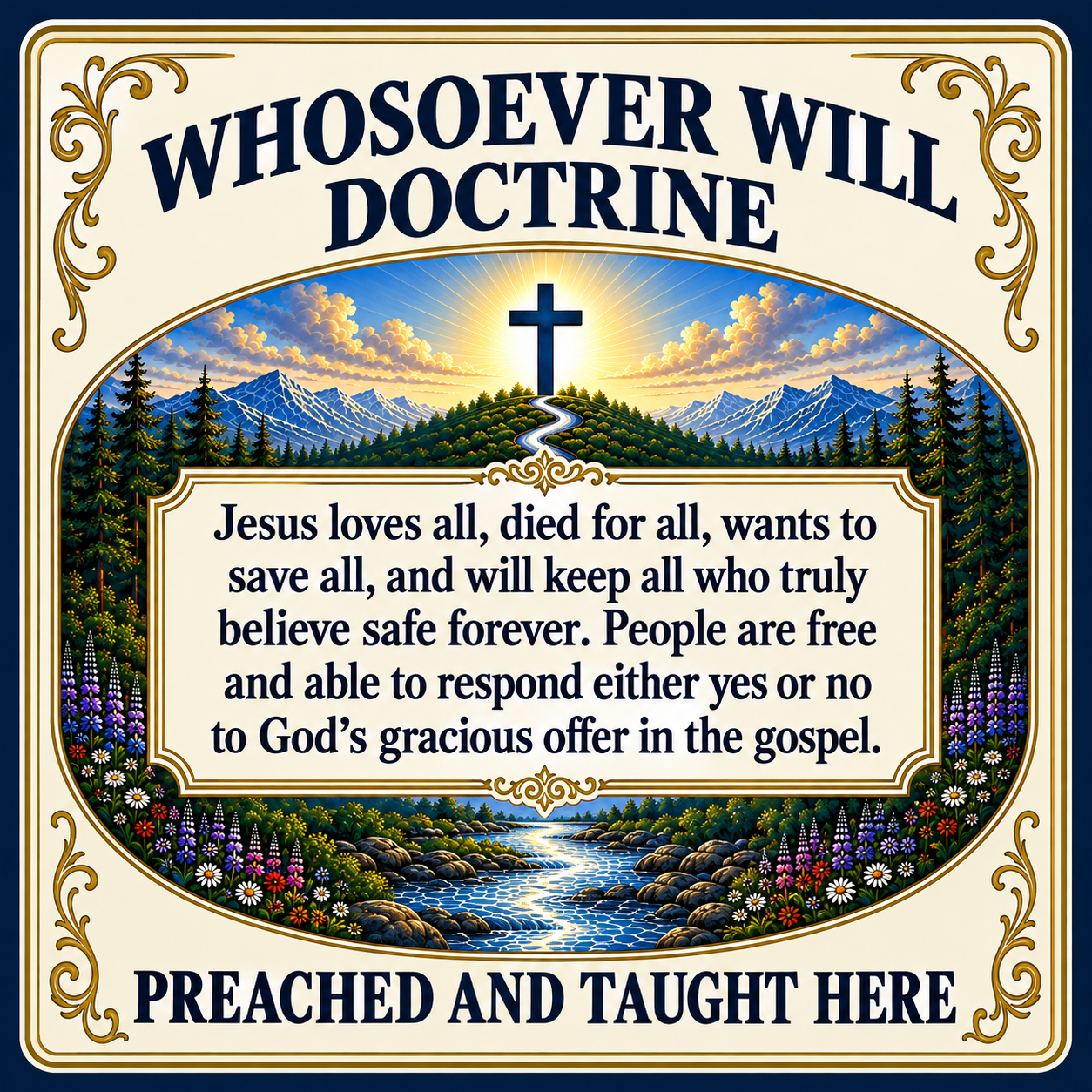
The Whosoever Will Tenet
The Whosoever Will tenet, consisting of one sentence about God and one sentence about man, presents ten important doctrinal concepts within a thirty-seven word statement. In layman's terms, when Whosoever Will salvation beliefs are preached or taught, sermons are more reminiscent of Billy Graham or Adrian Rogers than John Piper or John MacArthur.
Jesus loves all
God's love for every person is the foundation of sound biblical theology. Since the Bible tells us that "God is love," this is a good place to start. (1 John 4:8, 16) Such an affirmation distinguishes our doctrine from that of Calvinist minister D. H. Kuiper, who has written: "God does not love everyone, but He loves a people chosen in Jesus Christ," and "His love is particular, for it burns not for every man, but for a definite few." (D. H. Kuiper, "The Love of God," Monergism, accessed August 27, 2026)
died for all
Because of God's love for every person, the Bible teaches that there is no one for whom Jesus did not atone. "He himself is the atoning sacrifice for our sins, and not only for ours, but also for those of the whole world." (1 John 2:2) This stands in contrast to the doctrine of Calvinist John Owen, who has written: "Christ in their stead and room suffered for all the sins of all the elect in the world." (John Owen, The Death of Death in the Death of Christ (1647), bk. 1, chap. 3, Christian Classics Ethereal Library, accessed August 27, 2026)
wants to save all
The Bible teaches that God "wants everyone to be saved and to come to the knowledge of the truth." (1 Timothy 2:4) He does not want "any to perish but all to come to repentance." (2 Peter 3:9) Since God loves everyone and Jesus died for everyone, it logically follows that He desires to save everyone. In contrast, Calvinist theologian David J. Engelsma writes: "God loves and desires to save some only and…He hates and wills the damnation of the others." (David J. Engelsma, "A Candid Confession of the Character of a Conditional Covenant," The Standard Bearer 73, no. 11, March 1, 1997)
and will keep all who truly believe safe forever
Everyone who genuinely believes in Jesus receives eternal life, will never perish, stands eternally secure, and cannot lose their salvation. Jesus said, "I give them eternal life, and they will never perish. No one will snatch them out of my hand." (John 10:28) In this case, Whosoever Will doctrine aligns with the view of Calvinist theologians: "The perseverance of the saints means that all those who are truly born again will be kept by God's power and will persevere as Christians until the end of their lives." (Wayne Grudem, Systematic Theology: An Introduction to Biblical Doctrine, Grand Rapids, MI: Zondervan, 1994, 788.)
People are free
God created people with genuine free will—the ability to make meaningful choices for which they are morally responsible. "Choose life so that you and your descendants may live." (Deuteronomy 30:19) "But if it doesn't please you to worship the LORD, choose for yourselves today….As for me and my family, we will worship the LORD." (Joshua 24:15) Calvinist D. Martyn Lloyd-Jones counters: "There is no such thing as free will in fallen man…. The only man who's ever had free will was Adam…. Since then, there's been no free will." (D. Martyn Lloyd-Jones, "Holy God, Fallen Man," sermon on Romans 9:19–24)
and able
While "there is no one righteous, not even one" (Romans 3:10), our depravity does not mean that we are unable to make free choices. Because "God created man in His own image" (Genesis 1:27), we possess a mind, emotions, and will able to make choices. Calvinist R. C. Sproul writes: "Man is morally incapable of choosing the things of God unless or until God changes the disposition of his soul." (R. C. Sproul, Willing to Believe: The Controversy over Free Will, Grand Rapids, MI: Baker Books, 1997, 165)
to respond
The doctrine of man's responsibility—to cite the memorable wordplay—means that man is "response-able," or capable of responding to God and accountable to repent, believe, and obey Him. Since God "commands all people everywhere to repent" (Acts 17:30), the implication is they are able to do so. The Bible tells us to "confess with your mouth" and "believe in your heart" and "you will be saved." (Romans 10:9) Calvinist John MacArthur said, "The depravity of the sinner…renders it impossible for him to respond to the gospel." (John MacArthur, "The Doctrine of Actual Atonement, Part 1," sermon preached 11-7-2004)
either yes or no
People in heaven could have rejected Christ and gone to hell. People in hell could have accepted Christ and gone to heaven. Jesus said some "are not willing to come to me so that you may have life" (John 5:40) and "Whosoever will, let him take the water of life freely." (Rev. 22:17) Calvinist Franciscus Gomarus states: "These elect never become reprobates and perish." Conversely, "the reprobate never can become elect," because "the reprobate cannot believe." (Franciscus Gomarus, "God's Predestination," theses 21, 25, and 32, in The Works of James Arminius, vol. 3, 1875, 521-658, A Puritan's Mind)
to God's gracious offer
While not an irresistible or pre-gospel work enabling humans to make spiritual decisions, the priority of God's grace means God always takes the initiative in salvation. The Word of God teaches that "we love because He first loved us." (1 John 4:19) Paul taught that "the grace of God has appeared, bringing salvation for all people." (Titus 2:11) Though we may disagree with Calvinists on the nature of God's grace, we both affirm its priority. Calvinist R. C. Sproul wrote: "The initiative is with God, not with us." (R. C. Sproul, The Mystery of the Holy Spirit. Wheaton, IL: Tyndale House, 1979.)
in the gospel
God's grace is revealed in the proclamation of the gospel as the Holy Spirit graciously convicts, illuminates, and draw sinners to Christ. "For I am not ashamed of the gospel, because it is the power of God for salvation to everyone who believes…" (Romans 1:16) Calvinist Louis Berkhof regards gospel proclamation as insufficient to regenerate those who are spiritually dead: "The truth of the gospel can only work in a moral and persuasive way. Such an instrument has no effect on the dead." (Louis Berkhof, Systematic Theology, Grand Rapids, MI: William B. Eerdmans Publishing Company, 1949, 471.)
Together, these ten affirmations present a biblical understanding of salvation upholding both God's gracious initiative and man's genuine response. God loves all, Christ died for all, and through the gospel God graciously calls all people to repent and believe. Those who truly believe are eternally secure in Christ. This is the heart of the Whosoever Will tenet. "Let the one who desires take the water of life freely." (Revelation 22:17)
Special thanks to my Pastor Dr. Rick Patrick at First Baptist Church of Sylacauga, AL for writing this confession.